
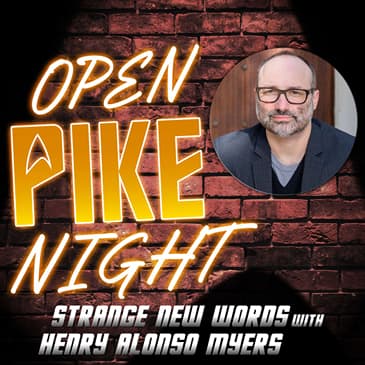



Star Trek: Strange New Worlds showrunner Henry Alonso Myers stops by to discuss his love for black holes, monsters that want to kill you, and dragons! He discusses balancing Kirk and Pike, challenging actors, and writing a finale that might be for the series, but certainly the season!
- Send your voice hail to OPN
- Email your call to openpike@gmail.com
- Sign up for the OPN Newsletter
- Visit our website OpenPike.com
- Please Check out our Merch
- Support us on Patreon
- Follow @openpike on Twitter
- Follow @openpike.bsky.social on Blue Sky
- Follow OpenPike on Instagram
- Follow Openpike on Youtube
[00:00:00] This is Henry Alonso Myers and you're listening to Open Pike Night's Strange New Words, where the future is already written, but you'll have to sign an NDA to see it. Is this thing on? Hello, hello.
[00:00:35] Welcome to Open Pike Night's Strange New Words, where we ask the writers of Strange New Worlds to look back in time a year to try to answer questions without spoiling things a year from now. I'm your host, John T. Boulds, and joining me as always, the podcast host who could only be described as a great white hole. Host of Green Shirt and Newbies Directly to the Next Generation, Cameron Harrison. Just call me Monstro? I don't know. That's the only thing I could think of that wouldn't get me canceled.
[00:01:02] And unfortunately, the host who loves looking too closely at consoles, way too close. Jesse T. Bailey could not be with us today. I'm sure he'll be fine in the end though. And joining us once again, please welcome back, not just a writer, but one of the fantastic showrunners of Strange New Worlds. Welcome, Henry Alonso Myers. Hi. Good to see you guys. Good to see you. Thanks for once again joining us for Strange New Words.
[00:01:28] We are here to talk about Season 4, Episode 10, Tomorrow's Enterprise. And first off, excellent. Fantastic title. Like it just, it promises right out the gate. Well, that was an early, that was an early one for us. I mean, you know, how do you find a title that feels classical, but is yet, and yet it's also something they haven't done yet.
[00:01:53] You know, it works, man. It works. It makes sense. And like you said, it did. It, I can imagine it was an early one. And as soon as somebody said it, like, well, that's it. That's the title for this episode. I don't remember entirely. I'm pretty certain that this was one that I was like, I wanted to call it this from the very beginning because like I just finished it back pocket.
[00:02:16] You have a lot of these things that you're, we have lists of things on a board and some of them have been around since season one and some of them just popped up in a moment of inspiration. And, and mostly at the end of every season, we usually look at them and think, oh man, we weren't able to do this one or this one or this one. So this is, this is one of those ones that we've had, you know, in our back pocket for a while.
[00:02:40] Very cool. And so get into it. Beginning of season four in the writer's room is pitching ideas. How did you all land on a time travel story? You mean a second time travel story? Yeah, another time travel story. Yeah. The global thing I would say is it is that going into season four is usually a good time to kind of change it up. It's very easy to start falling back and doing the same thing. Like, because you're like, Oh, this work before we should try that.
[00:03:09] And then my own personal instinct or what time and working on lots of other shows has taught me is that you really, you, you shouldn't. If that is not the time to do it, it's sort of the opposite. So I wanted to say in like season one, we started with a Pike episode. We ended with a Pike episode. And season two, we had some different challenges that forced us to flip the switch on it because of cast availabilities.
[00:03:39] So frequently you have a production issue that just drops into your lap and you just reschedule things and lean into that. Like it's make it, don't make it a problem. Make it a solution. Make it an interesting challenge.
[00:03:53] So the, the, the, the big thing for this one was we could have done exactly what we did season one and give people the same order that they were used to, but we really just sort of wanted to flip it up. And one of those things was we thought this possibly could be the last one for the show. Mm-hmm.
[00:05:08] Mm-hmm. And we thought it would be great to close the series with her to see, uh, get a sense of her change, uh, her growth and talk about her move to the future, who she's going to become, who we are familiar with. Mm-hmm. We, we, we know who she's going to be in the original series that we wanted to show how she's moving toward that journey. Uh, so, uh, it, it was a lot of elements like that.
[00:05:35] So did you, when did you find out about season five? Was it before it was filmed? Is this episode as written? No, we actually made some, we made some alterations in the script. I want to say, before we went into production, it was somewhere in that timeline that we found out about the pickup.
[00:05:56] Mm-hmm. Um, I don't remember the specific date. Sure. Sure. But it was before you filmed, so you were able to make some adjustments knowing you were going to have six more episodes. Correct. Correct. I would say that there were some big things that we didn't do because it wasn't the end. And then there were some small things that we just did to alter the story. Mm-hmm.
[00:06:18] Mm-hmm. The, the genuine challenging thing, if you look back at every season was, uh, I had always personally wanted there to be a time travel episode in every season, but I wanted to do one that was completely different. Uh-huh. And if we thought this was the end, this was one of the time travel things that we had not told, you know, we had done a time travel episode as the season opened. Do you know what I mean? Yeah. Yeah. Yeah. So this is one that was, uh, completely different. Mm-hmm. Mm-hmm.
[00:06:47] So I think a lot of what we talked about was, oh my God, what was the original film? Is it frequency is that I was thinking of? Oh yeah. Oh yeah. The shortwave radio. Yeah. Well, it was had this idea that like, all right, you know, she's a comm officer. What if she could talk to somebody and it turns out to be her and it's her in the future? Mm-hmm. Mm-hmm. And then we were sort of like, how can we work with that and make it more interesting? Because when you get to talk to your future self, you get to learn things from them.
[00:07:13] I mean, that movie was about a man talking to his lost dad. Right. And this is sort of like about the horror of talking to a horror. Mm-hmm. Mm-hmm. And the goal was to find a way to cut back and forth and have there be a story that she could learn something from her future self and her future self could learn something from her past, you know?
[00:07:34] Because I felt like that had great emotional value and could take the audience on a journey that, I don't know, just showed the importance of the life that Uhura has gotten to lead on our show and on the shows to come. Mm-hmm. So that was sort of the idea. And then we sort of built up on that and tried to do some other crazy stuff. Yeah.
[00:08:00] I mean, you get a lot of great interplay of, uh, of the two of them talking and getting to solve a problem together. Yeah. A lot of great character stuff there. I'm going to take a quick detour into science land though. Yeah. Talk about white holes, which at first I was like, I've never heard of a white hole. What are these writers doing? Just coming up with their own science. It's for real. Apparently it is. Yeah. Can you talk about like how much the science informed the story and vice versa with this one?
[00:08:27] Gosh, I'm going to have, this is one where I'm afraid I'm digging into some, some older stuff. Just phone up your past self and ask them for help. Well, I mean, I, I, as a, as a young man, I was obsessed with black holes probably because of the movie black hole. Sure. Which was, uh, insane and really had nothing to do with black holes, but it stuck in my head. Yeah.
[00:08:52] We were looking for a way to create two different locations, partially from around the ship and partially for the, for the AR wall that could connect them. Uh, and the idea is that, you know, like I think that there's, there is no sense of what is, uh, other than, you know, a lot of theoretical physics around what, what exists at the, at the center of a black hole or a white hole.
[00:09:16] Um, I, I want to feel like we, we, uh, we, we went to the, some of the same space that interstellar went to, you know, and interstellar to their credit did some amazing VFX work on black holes that were like deeply different and more accurate than had been done before. Um, and so the version of the black hole that we ended up doing was, is very much in that, in that same realm.
[00:09:44] Um, I want to say, I, I was going to dig out my book on, on, uh, on physics and black holes, uh, that was done by this guy who was a professor at Cornell, uh, which is the town that I grew up in. Um, he had been friends with another friend of mine and so forth. And I've been hearing about it for years. And then he was a consultant on, um, on interstellar, which my brother produced. So I spent a lot of time talking with him about how they approach it on their show.
[00:10:14] Oh, okay. Obviously we spent a lot of time internally talking about it with our science advisor, uh, Dr. Aaron, who had a lot of strong, uh, interesting feelings. She's incredibly bright, far smarter, uh, than any of us when it comes to science. So it's very helpful to have a way to talk to her. Um, but you know, this is a, this is temporal dilation and elements like that, which I think are, uh, are super fun. Yeah. Some of that we just simply break.
[00:10:45] Yeah. But some, but some of it we don't, you know what I mean? I think that's the great thing about a lot of elements of physics is there is an area where the people who study it don't actually know what is happening. So, you know, from the perspective of writers who are telling stories, you get to play with it. Okay. You know, science hasn't proven that black holes aren't a uterus for space babies. Yeah.
[00:11:14] Well, you're, you're suggesting that those things are connected. And what we are suggesting is that black holes and white holes exist and space babies, uh, exist, but in a completely separate space. It's a little bit like saying like we exist on earth, but that doesn't necessarily mean that we're the only thing that exists on earth. All right. All right. In a different dimensional space, it's hard to know what exists there and, and does life exist in the way that we think of it? Mm-hmm.
[00:11:42] That was really the idea, uh, which I think is actually a, it's, it's not that far off. It's funny because we were, I was talking earlier with you guys about the children of the comet. It's not that far off from the creatures that they find, you know, the, the remnants of on, on the comet itself, who had a completely different way of perceiving reality and perceiving, uh, the world and speaking through song. Yeah.
[00:12:10] The thought was that like one of those things that I, I particularly love about Star Trek and we've, we've hit this on a number of episodes is there are creatures who exist or live in a space that we don't totally understand. And one of the wonderful things that we can do on Star Trek is cross those spaces over. Um, and you know, I personally think it's probably more Star Trek to find a way to connect us rather than to be like, Oh my God, it's a monster.
[00:12:39] It's going to kill us. But I do like the, Oh my God, it's a monster. It's going to kill us stuff as well. Just, just, uh, I don't think that's, it doesn't really feel like how you want to end this possibly the show, but for certain the season. You know what I mean? You put the love in Lovecraft. Understood. It's exactly right. It's exactly right. It's a good way of putting it. And speaking of different things existing differently, uh, the characters on Kirk's enterprise do feel different in different ways.
[00:13:09] Did you have a guiding principle for the way you wrote them? We wanted to imply that, uh, they have a journey to go on to become the people who we would come to know. Mm-hmm. And they hadn't yet gone on that journey because if they're playing it exactly the same, it maybe isn't, you know, they're not shooting the episode that happens tomorrow. They're imagining that they had a life and events and things, which is really how we approach the show to begin with. Okay.
[00:13:38] Which is to say, nobody knows what they're going to be like in one year, three years, five years. Um, they just know what they're going to be like today. And they probably don't. They probably don't even know. I don't like, I don't know what I'm going to have for dinner tonight. And I think that that to me is the, has been the great, refreshing, completely easy and relaxing way to approach a prequel. Um, which is that your characters don't know what the audience brings to it.
[00:14:06] The audience brings a lot of shit into it and, and none of the characters have any of that. Yeah, it's true. You know, so why would they? Pike is the only one who has some element of that. He's the only one who knows something about his future, but even he has to learn how to live with it. So a lot of what our goal was, was to create two different emotional spaces for our actors to play that had some difference.
[00:14:35] Part of that is to give them something to play. And part of that is to imply a mystery so that you have something to live through as we get there. And part of that is to, is to show that like we have a, an understanding and a respect for the changes that these characters are going to go through between here and there. That's kind of it. Now, speaking of these characters and futures, you were given an opportunity to naturally fit in an appearance by Sulu or McCoy. Was there talk of doing that?
[00:15:04] Why did you guys decide not to? You do have some precedents of introducing TOS characters and finales. Uh, we did talk about it quite a bit. I'm going to leave it at that. Fair enough. Well, cause we talked about it quite a bit. And then, and then when we had, we, you know, yeah, I know I'll leave it at that. Or I'll keep going back and forth. So I'm not going to leave it at that. And then I'm going to leave it at that. Well, let me, let me posit this.
[00:15:32] You were going to, and then you found out you're getting a season five and maybe things changed. Um, that is one possible time travel solution, but it's not necessarily the truth. Okay. Okay. That's fantastic. That's fair. Uh, I mean, here, here is the reality. Like, uh, this stuff, the stuff that we're talking about is fun and interesting.
[00:15:58] And we want to do it if we can raise the bar and make it really cool. But the thing that's most important to us for every single episode of all varieties is, is what's going on with the characters. Like this is really about Uhura. Uhura. So it was like, it ultimately followed the journey of what's happening with Uhura. How does Uhura learn about what her future is going to be? How does future Uhura learn about what her past is going to be?
[00:16:26] And how could we make that journey important and mean something to her? And then thus to the audience. Yeah. Yeah. And that makes sense. It's, and fans have been worried about the fates of characters we do know and have seen, uh, the original character. You know, we got La'Anne. Um, I know we're happy to see a post Starfleet Ortegas, even though you did kill her in the episode two. We got to see Ortegas both blow up and not.
[00:16:55] And a visibly upset Jim Kirk when La'Anne is mentioned. We see Scotty die. We see like. We see Scotty. I know. Should we take the future we see in this episode as canon or was this merely a possible timeline? I, um, don't take anything as canon. I, or, or take everything as canon. But the intention here, honest to God, is to imply that we have a different interesting future and there's some drama to unfold. Do you know what I mean?
[00:17:24] But we don't tell you how everyone's ultimate fate is going to go out. We don't at all. Right. I mean, we, we, we, we, we imply that there will be journeys, but that's about it. Like, I would not read this like, oh my God, someone's going to, you know, how's Scotty going to die now? Right. So, yeah, I mean, clearly there is a bit of a mystery about La'Anne set up. Are we supposed to take that as like, ooh, what's going to happen to La'Anne next season?
[00:17:52] Or is there a butterfly effect in this happening in this episode where like, well, everything's suggested there. Maybe, maybe not. Part of the fun of being a writer is sometimes you get to make people very happy. And sometimes you get to make people very sad. Sometimes you get to make them laugh. Sometimes you get to scare the crap out of them. And the job isn't to make everyone feel safe.
[00:18:17] The job is to give you a, a story that is compelling. That's really it. Is Ortega safe? Can people feel comfortable that Ortega is safe? That's what Jesse is asking with this question that he wrote that he wanted us to ask you. I think I should say no one is safe because we don't know their, we don't know what their future is. Yeah. But I will also say we love our characters. So, you know.
[00:18:48] I'm just going to leave it at that. Does he really want to know? I mean, he says he does, but no. I think you have six really good episodes that will, that will tell you some story. Like, that's all I can say. Like, all right. And I think you'll look forward to them and I think you will enjoy them. I promise you that. All right. We'll leave the future alone for now. Okay. Kirk's enterprise in the future features far more aliens than Pike's enterprise.
[00:19:16] Is there a reason for this beyond season finale budget? A lot of them came from the animated series and that we just wanted to try to lean into some background aesthetics that we could keep alive. I mean, like, it's always been implied that there's lots and lots of aliens on the ship. We just, sometimes we always see, we just don't have time or energy or budget or whatever to see as many of them.
[00:19:44] So part of that was they'd done some really great creature designs for us. And so we wanted to put them through and imply that the future that you see in the animated series has a reality that exists. You know what I mean? Yeah. Yeah. So it's not that Pike is a raging xenophobe. No, no. Yeah. I mean, like you can recognize quite a few of these. Yeah. Is that supposed to be the same character from the animated series, the Cation?
[00:20:11] It is a Cation. It's not the Cation in particular. Yes. That was the idea. That's cool. Yeah. Well, beyond the call forwards to the animated series, Aliens, we get a lot of nods to different TNG episodes in this episode. So as this is, this is more of a like in the writer's room question. I hadn't noticed that. Yeah.
[00:20:34] But with the poker, the space babies, backwards and forwards, anomalies through time, the episode title, were these all intentional hearkening to TNG with those references? Or was it also somewhat just the fandom of the writers' room showing through? I would say 90% of the time it's intentional. Okay.
[00:20:53] I mean, part of the goal of the show, and I feel like I, gentlemen, I am so sorry if I've said this a thousand times, but I'm going to state it again, which is to say we wanted to create a show that was Star Trek for everybody, that was showing a version of Star Trek that would win over people who had never seen Star Trek before.
[00:21:12] And we wanted to do a prequel that gave fun, secret, interesting things running throughout for people who love Star Trek that they would watch and think, oh my God, they put that thing in for me. And the answer is yes, we put that thing in for you. We did that. That was why we did it. Like, we did it because we love Star Trek. We know someone else loves Star Trek the way that we do, and we wanted you guys to have some extra fun in this.
[00:21:40] So, like, there's something for everybody in the show. That was really the goal. Well, I thought it was interesting. There were so many kind of call forwards to the animated series and TNG in an episode where we're looking forward a year and perhaps beyond. Were you trying to get, like, the audience mindset thinking that? Or are these just, like, things in writers' back pockets they wanted to get in in the finale? These were things that just happened to work out in this specific one. Yeah. You know what I mean? I mean, part of it is also, like, trying to imagine the future. You have a lot of elements to play with. Yeah. You know what I mean? Mm-hmm.
[00:22:10] So, it's sort of like, what can we get? What can we try? Let's try this. Oh, this helps to try here. You know, it's a lot of that. Well, and another reference, of course, to Star Trek V, which gets a lot of nod this season, is the romance between Scotty and Uhura. Yeah. Did you guys always think you were going to play with that element of those characters ever since you introduced Scotty? Or did it kind of just come up naturally this season? A little bit of both. I mean, I'm glad you brought up Star Trek V.
[00:22:39] I mean, part of that was the implication in that was that there was something going on behind the scenes. Mm-hmm. That they had, like, an interesting chemistry. I just think it's, like, the reality of the future is that these people work together and occasionally they will fall in love. And obviously that's something that we tend to like on our show is Trek in that kind of a story. I mean, the actors work very well together.
[00:23:05] Part of it was, like, what you get to do in a prequel is deepen and explore ideas that were just implied in the future. I mean, one of the other things that we talk about a lot is Kirk's son, which was stated late in the game for them. But I'd like to imagine that the Kirk that I know would actually be kind of a good dad, you know. And there's literally no reason to suggest that he wouldn't.
[00:23:32] And I don't think it undercuts everything that we've explored before. Plenty of single dads have had many relationships like Kirk does, you know. But, like, so let's just make him a human being and imply that he's, like, not a jerk. He's actually maybe a good dad. So I think the same thing applies to their romance.
[00:23:53] It was kind of like this would be a fun, real journey that we get to explore with two characters who didn't often get this kind of a thing on screen. I mean, part of our job was to take the characters and deepen them. Like, let's make Uhura not just a symbolic character who has important meaning. But, like, let's give the actress something real to play that comes from character.
[00:24:22] Like, let's show the audience the journey that helped make her who she was. That, to me, is the real fun of this. So, you know what I mean? Like, I love those two characters. So why not? Why not indeed? Yeah, that's it. Because I also think if we can find a way to deepen something that was implied later, that's like a prequel win as far as I'm concerned. 100%.
[00:24:46] And it's one of the things I think you get to do in TV in a way that they don't even necessarily get to explore in movies. That makes sense. You know what I mean? Because a lot of what we do is, hey, this thing was established. Oh, what if we went back and found another reason for this and make it deeper? Like, give themselves an emotional thing to play. So that was, you know, that was where that came from. Yeah. And we get a lot of Uhura. We follow both versions of Uhura pretty equally up to a point.
[00:25:16] But then our Uhura prime takes over more in the second half of the episode. Was that in the script or was that in the editing? No, that was in the script. I mean, the intention was that suddenly they can't talk. So suddenly she was in a place that she is unfamiliar with and has to deal with the problems of it. And how would she deal with it? Because she doesn't have her future self around to tell her how things changed or what to do. Do you know what I mean?
[00:25:45] Like, that seemed like a real, that seemed like a genuine character problem. Because, like, we've had them talk and exchange things for several acts. And at some point this flipped the script on them. Part of that is just put her in a very challenging, difficult position. Put her in a position of something that she is not that person yet. How could she handle it? How would her future self handle it? And then kind of having to learn about her future self by looking inside. That was part of the goal.
[00:26:15] Kind of going back to the germ of the episode real quick. It is kind of two different time travel episodes, right? Like you get, she gets to talk to herself and work with herself. And then you get, they swap places and their bodies time travel. Were those kind of like two different pitches that then the writers were like, well, why don't we do both? Because watching it, it makes sense that you kind of keep, you know, every act, it changes a little bit and keeps from getting stale and makes the journey fun.
[00:26:41] I think that the goal was to, every act is a big surprise that expands the story. And we just kept playing with it. So that each, each act kind of blew up the last act. That was the, that was to me is a, that to me is a win. Because as a, as a viewer, you want to find out what's going to happen. And that's honestly how we approached it.
[00:27:07] It all kind of come down to like, what's the, what's the next thing for present to her to have to deal with. Right. Yeah. I don't know the transition here then. So we heard Henry that Admiral Rieger's coffee habits are somewhat based on yours, perhaps. And in this episode, we have a particularly explicit coffee pouring shot. Yes, we do.
[00:27:37] How do you like your coffee, Henry? It depends. I actually have not had my afternoon coffee yet. So it depends. I usually make espresso or, or a cappuccino or a flat white in the morning. Okay. And then in the afternoon, depending on if I have access to a machine or if I'm going out, I may get that. Although lately it's been so hot, I've been having a cold brew. I also like making a pour over.
[00:28:05] When I got my first TV job, as you may remember, I mean, I was, I was extremely lucky. I think I, I, it took me about five years to get my first gig. And it was five years of not making a lot of money and living in an apartment. And so I, I, I, I remember I paid off my student loans and I paid off my car loan and I bought myself an espresso machine. The three priorities. There we go. That was it. That was it.
[00:28:34] And, and I have, I feel like I've bought a new one. I think I've gone through three or four of them and then I have a million little pour over things that I bring with me. I think I left one, I left one in Canada for about five years. I've left one in New York. I've left one, I've left one in Ithaca at my mom's house. I left several in New York. I've given them to a lot of different people. I think I probably have six of the AeroPress.
[00:29:04] Yes. Yes. I knew I liked you, Henry. I knew I liked you. AeroPress is outstanding. AeroPress is outstanding. AeroPress are terrific. I use those. I probably have six or seven. I have a Chemex that I love that I use pretty frequently. I think I have two or three of those. I have limited in the amount of coffee I could drink in a day because it would leave me feeling very sick. So I can have two usually and I have one in the morning, one in the afternoon.
[00:29:31] And I really care about the ones that I'm going to have because I can't keep drinking it. So part of it is like I would rather drink one that I really liked than six that are just available and not right. Listeners, notice he never mentioned a drip machine and that is for a reason. Terrible coffee. I'm with you. I mean, yeah, because it repurposes the beans. It gets very bitter.
[00:30:00] It's not, you know, I don't, I am not, despite my love of that, I'm not actually very judgmental about how people like their coffee. I think people can like them however they want. It's just not my personal preference. It's like one of those things where you start learning how to make it better. And then afterwards, you just can't go back. And it's a little bit like, oh, so when I'm traveling and I'm in certain areas, I usually like figure out where to get decent coffees.
[00:30:30] All across the map. Coffee machines are to you like typewriters are to Tom Hanks, it sounds like. Apparently he has a typewriter thing. The two things I care a lot about is making coffee and baking bread. Oh, yeah, that's right. Which obviously don't show up at Star Trek that much. When you came, I might have been. Well, it did have an, I mean, it was nice to have a strong influence on Pike's cabin.
[00:30:59] That was really the whole concept of cooking. I think I made an argument for that and it really stuck and it helped. I mean, part of that is like we're absolutely borrowing or reflecting on some of that stuff from Deep Space Nine. Like, I also thought it's a great way for the characters specifically to have a place to come together.
[00:31:24] Like it made for great scene work and it made for great ways to have the characters learn things about each other, reveal things about each other. Some of my favorite scenes that we were able to do on the show were like cooking scenes in Pike's apartment. The four and a half Vulcan's dinner scene. Oh my gosh. Oh, do you mean the charades dinner scene? The charades dinner scene. Oh, yeah. The charades dinner scene was probably the, that was one of my personal favorites.
[00:31:52] Like that was just a, it just, it just fit into a lot of stuff for me. Excellent. Yeah. Sometimes I like to write the explosive blowing up everyone's dying type of episode and sometimes I like to write that one. That makes sense. Yeah. This is more of a, I think this one is much more of an emotional time travel. Oh, yeah.
[00:32:19] Like I feel like this is a straightforward, but surprising classic version of Star Trek. It's one that they haven't really done. They've done a lot of versions like this, but not this particular one. I agree with that. Yeah. Yeah. And I've done, and I've, I've done a lot of shows on other TV series where we've done, you know, alternate timeline, different versions of people.
[00:32:46] It's one of those great elements that it's really fun to bring to actors because it gives them something unique and specific to perform. I mean, part of our goals on this show, and I think it's, it's a, it's a little bit of a, I have a fundamental philosophy about like hire people who are talented, ask them to do things that are challenging. Let them rise to it, use the stuff that they bring to it because they tend to bring something better.
[00:33:10] And it goes from all the way from the writers to the directors, specifically to the cast, like being able to be like, well, this week you're going to, you know, nearly get chopped in half and you're going to bleed to death. Maybe is one thing. And then the other one where it's like, you're going to wear a funny hat, but you're going to act like it is not funny. Or for the last half of the season, you're going to be your evil twin brother. You're also going to be in a coma.
[00:33:40] You're also going to be a future version of yourself and a wizard. Go for it. I mean, yeah, that was a, that was a lot of like that, that episode in particular where everyone got to play two versions of himself is pretty insane. Oh my God. Uniquely challenging and pretty insane, but like I will, I will tell you this, our director of the episode is uniquely talented and able to do it.
[00:34:07] But the thing I wanted to really point out was the lawn fighting lawn is one of my, one of my favorite things that we've ever done. It's Star Trek. It's so good. And, and, and as a person who loves science fiction and, and also fantasy getting a dragon to fight the enterprise. Oh my God. That's a, that's a, that's a lifetime win. Oh, I couldn't be happier by whatever reaction comes to that.
[00:34:34] I mean, the dragon is incredible for sure. It's a delight. It makes me so happy. The moment and, oh, what are the characters names, but the, the Pike and Spock fantasy characters. Oh, enterprise. Oh yeah. And I realized like that whole subplot was going to happen. One of my happiest moments watching Star Trek. Like I was like, I, of course they were going to do this. I didn't. Part of that was, oh my God. Part of that was so fun was just that, that Anson is a, it was having so much fun playing this role.
[00:35:04] Just giving him a chance to play one role, trying to play the other role. Like, it was kind of like, just try this. See what you bring. Like, just try, you know, it's kind of like, it's, it's still, it's a delight. And I, again, I think this is one of those things where you get to, you get to hand over things to actors and let them bring some element of interest. Like their job is not boring. I have a, I have a flashback to when I was years ago, I was on the show charmed.
[00:35:34] And I remember it was like a transitional scene at the top of like act two or three. It's usually the scene where everyone comes to get all the, all the girls would come together. They discuss, well, I'm going to do this and I'm gonna do this. And then they'd all exit. You know what I mean? It was like the scene where you keep the plot moving. The ready worm scenes. The three girls came in and they were like, we're going to sit down on the couch and just sit there, say the thing.
[00:36:00] And it was like, the thing that I took from that was, however you may feel about the script, your job, we weren't making their job interesting or compelling. And, and you can, and you can read it on screen.
[00:36:14] So the lesson I took from that was your show will be better if you can give the actor something real to reach for and play that requires work from them, make their job interesting, make them have to do things that challenge them. And they end up looking better. They end up coming off better. They have a reason to ride. You know, they have a reason to wake up and come to, you know, like no one does this because they want to just phone it in.
[00:36:45] You know what I mean? So don't let them like rise to their challenge and, and, and flip it back. Make them bring something interesting. And they, it ends up being like, we all went into this field because we liked creative work. You know what I mean? So give them a time to be creative. So, I mean, the core of this was to have Celia play herself in two different timelines and play scenes with herself.
[00:37:15] Yeah. That's a unique problem that you wouldn't see on another show. Let it, let it come from her heart. Let it feel real for, from my perspective, it makes the show better. So anyway, that's, that's, that's the end of my rant. That was a great rant. I loved it. Yes. So we have seen one season finale so far of Strange New Worlds that highlights the differences between Pike and Kirk and their captaining styles.
[00:37:40] And was there a conscious effort to really show, illustrate some of their similarities as, as captains in this episode? Um, they kind of form a united front together a year apart from each other. It's true. It's true. I mean, part of that was, again, with the, they are very different captains. They have a lot in common, but they have very, very different ways of approaching things, I think.
[00:38:07] And a lot of what we tended to lean on in, um, the Kirk episodes in particular was showing him going on that journey. It's tough because I think that people from the outside might not recognize it. And so, uh, they might just be like, oh, he's a captain. He's doing captain-y things. I don't know. I don't think much, much about it, which is fine. Um, that's, I don't actually, I genuinely don't mean that as a criticism. I mean that like viewers, they don't always think deeply, but boy, do they understand things deeply. Do you know what I mean?
[00:38:38] So if they don't feel a difference and it isn't clear to them, like on some emotional level where they're like, well, they both do this thing. Like, you need to think deeper about what you're doing. So a lot of that was about, um, giving Anson, uh, as much as we could on the page so that he would have something different and real to play. I got to give him a lot of credit. He is a really great deep thinker.
[00:39:09] Rarely came at us with a lot of notes. When he did, they were always very thoughtful and they usually found a way to come out through, uh, his performance. And so a lot of this was, I remember, uh, it was a story about David Greenwald. He used to run Buffy. The thing that he would say in that room, apparently, uh, I don't know if this is true, but I like to believe it's true, is a show called Buffy.
[00:39:35] Meaning like when they were sitting in the room and they were walking around trying to figure out a story to say, they'd say, well, what can we do this? Can we do that? And he'd be like, well, show called Buffy. So that, you know what to do. I, I would be like show called Pike. You know what I mean? Like that's that it was always a good reminder that this isn't about Kirk. This isn't about any of these other people. It is on some level, but it is really about the character of Pike. And how do we reflect that and show him, uh, his own point of view? You know what I mean? How do we make him different?
[00:40:05] And that also required us to really look at Kirk and be like, we're going to do Kirk. Let's make sure that it feels like the Kirk we come to know. Um, maybe not there yet, but like that they need to feel different. There's a reason that one show in my mind got picked up to series and the other show waited around for. For, uh, close to 60 years before it came to series, you know? Yeah.
[00:40:34] And part of that was think deeply about who this person is. Give them something to make them different. When we thought this was possibly the end, uh, we wanted to find a way to bring them kind of together. We have a journey to go on next season. Um, there is a place for them to, for them all to go for real. Um, and I'm grateful to have gotten the time to show that stuff on screen. So, so are we. Yeah.
[00:41:04] Have I, have I answered your question? Yes. Oh yeah. Have I, all right. Well, I'm not going to say anymore. I hope Akiva is in agreement with me. He usually is. So, well, we'll, uh, preview our, our showrunner conversation with you both. Yeah. We'll find out next week. I don't know. I don't know. Whenever it airs afterwards. Whenever it's going to air. Well, one last question then, uh, where you will maybe have to speak for yourself or Akiva,
[00:41:32] but, uh, Robbie Thompson couldn't be here today and he is the other credited writer on the. Oh, Robbie's a, Robbie is a delight and a talent and a wonderful human being. Can you talk about his contribution to the script? Robbie made my life, uh, more fun and easier. And he's a great gentleman and a fun writer to work with. I've written scripts with a lot of different writers, uh, and he is top tier. So I would say, uh, I don't know.
[00:41:58] I don't know what else to say other than like, uh, we, we, we, we cover up the script together and, and, uh, he helped me produce it. So that was it. And we'll say for Cam and I, he's a hell of a set tour guide. Yes. Oh, and I just, a delightful human being. I mean, I, I, um, I was, I did not think I'd be able to hire him. He had written a spec script that I had read years ago. And it's like one of my favorite specs I ever read.
[00:42:26] And I just sort of reached out like, look, I don't think you're going to be available, but we could really use you on Stranger Worlds if you felt interested. And he hadn't, I think, seen the show yet or hadn't seen a lot of it and watched it all. And then, you know, came in and, uh, uh, surprised me by actually being available. So I felt very fortunate.
[00:42:51] Um, he, uh, you know, he understood everything from drama, humor, character, uh, world building, all the things that are required, I think, to do this kind of a thing. Um, it's harder than it looks is what I would say. You need someone who understands that and knows how to, uh, how to, uh, how to bring it. Uh, and he is one of those people. Well, it looks pretty hard. So yeah, big ups to everyone involved for sure. I mean, what you were saying about like, give it, you know, give people hard things to do and watch them excel.
[00:43:21] Like, and I feel like that is this season in a nutshell. So well, well done. A lot, a lot of swings. I know. I know. Uh, we, we didn't know what our future was, man. And there was very little that we wanted to leave on the table. Yeah. I can't say enough how grateful I am that we've got to do a season five. Uh, all shows. And it's just a question of when, and it's really nice when you get a chance to figure
[00:43:51] out your own way out. That is something I'm incredibly happy about. Not all shows. Very few shows get to figure out. Yeah. That's true. I know a lot, a lot of people were upset when they heard about it. I was like, no, this is good news guys. This is good news. They're going to be able to end it on their terms. Yeah. Very much. Very much. So, you know, and, and like I said, we, we, we love star Trek as most of you do. And we would let, we hope that that will cut out on the screen. So.
[00:44:20] And after this season, I would say you could say all shows end, but tell that to Deidre Hall. Cause. Did anybody tell her that all shows end? Well, it will end eventually. I said, it's just the last lines all shows end is just a question of when. And so the, the, when there is gone on a remarkable. Pike seemed pretty familiar with soap operas. So I don't know. Markable amount of time.
[00:44:48] I mean, it's, she's, I mean, I think she's still tech avail. So she was, she was a delight to work with as well. I bet. Yeah. I haven't listened to your, your, uh, Anna DeCosa. Oh, she was great. She's a delight, a really, really great director. Yeah. And a real find for us. A very tricky episode to do. Oh yeah. So finding, finding the right director for that.
[00:45:18] Couldn't, couldn't, couldn't love her more. She's really great. Yeah. Yeah. It sounds like you've picked all the right people. We had some excellent directors this season. Yeah. Yeah. Yeah. Well, as one of the writers of this episode, do you have a favorite line from this episode? I think that, uh, I love the part when, when, when over at the end says personal log stardate today. Hmm.
[00:45:45] It's the only day that matters and how you spend it, how you define it, that whole line, the whole dialogue on the way in. Mainly because I think it's, um, I think it's a definitive and very Star Trek philosophy about how to live your life. That, you know, the thing that is great about our show is it's an imagination of the future, but the truth about our show is it's really about today. How you live your life today. Cause these characters don't know their future.
[00:46:14] Like they only know what's happening to them now. Um, and they get to work with people that they care about and love. And that's a great way to live your life on this planet. You know what I mean? Mm-hmm. So I think that's, that's the line. Not to, not, not to get all emotional on you guys, but I'm sure there was a funny line in there. That was good too. She says, I'm going to spend this moment and every moment to, uh, to come doing what I love with the ones I love.
[00:46:43] Like that to me is the, like, you know, I may not know for the next few years we'll bring, but I know, uh, who I want to be with my family. Like that to me is like, that is why people like watching Star Trek. They like hanging out with these people. Yeah. That's why I like watching it. Yeah.
[00:47:00] And I think it's also the great gift that the show has is those people more than anything can show you the differences and strengths of people who are not like you and help teach you all the ways in which you maybe are like you. You know, I think that's a, that to me is Star Trek in a nutshell. Yeah. Thank you very much for joining us.
[00:47:30] Thank you. Of course. You are most welcome. Gentlemen. Yeah. It was a great episode. Great season finale. And, uh, we look forward to talking to you soon for the, uh, show at a retrospective. Oh my gosh. All right. Bye. Bye. Bye.