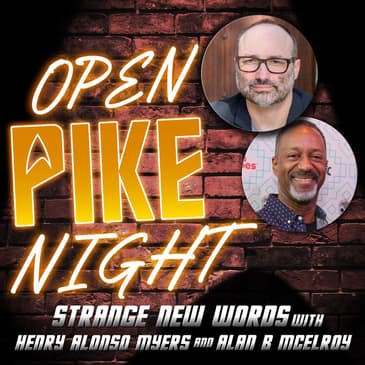



Kick off Star Trek Strange New Worlds Season 4 with the return of Strange New WORDS, where the writers of each episode discuss the story process and this week’s adventure!
- Send your voice hail to OPN
- Email your call to openpike@gmail.com
- Sign up for the OPN Newsletter
- Visit our website OpenPike.com
- Please Check out our Merch
- Support us on Patreon
- Follow @openpike on Twitter
- Follow @openpike.bsky.social on Blue Sky
- Follow OpenPike on Instagram
- Follow Openpike on Youtube
[00:00:00] This is Henry Alonzo Myers, and Alan B. McElroy, and you're listening to Open Pike Night's Strange New Words, where we discuss the origins of Star Trek stories. I'm not saying it was aliens, but it was aliens. Is this thing on? Hello, hello.
[00:00:25] Welcome to Open Pike Night's Strange New Words, the series that brings the writers of Star Trek Strange New Worlds on stage to talk about the episode you just watched. I'm your host, John T. Boulds, and I'm thrilled to kick off Season 4 with some amazing guests.
[00:00:54] A quick note, if you haven't watched Season 4, Episode 1, Vallas Marineris yet, stop listening because we're about to enter a spoiler territory 65 million years in the making. But first, let me introduce my co-host, the man who can sympathize with Captain Pike deciding be careful meant invite aliens aboard the starship to see our weapons in a moment of panic, host of Green Shirt Podcast, Cameron Harrison. Uh, I'm from the future! No! Quick! Pass, pass, pass!
[00:01:23] And today we welcome two voices whose words have shaped Strange New Worlds in so many fantastic ways. Writers who have brought the crew of the Enterprise to life for a new generation and most importantly, guests who have graced Open Pike Night's stage multiple times before. Henry Alonzo Myers and Alan B. McElroy, welcome back to Open Pike Night. Hi guys! Thank you! Hi! Great to have you here, both of you again. Glad to be here.
[00:01:49] Yeah, we're excited to do the Strange New Words series again, talking to the writers of each episode. Since this is our first one for any new viewers, I kind of wanted to kind of just do a quick primer on how the writers room works. Let me know if it's roughly accurate, but basically the writers room breaks each script, kind of coming up with a pretty detailed outline. And then the one or two chosen credited writers go off and write out the finished script. Is that relatively accurate? And then how does the story by credit, Alan's story by credit here, fit in?
[00:02:18] Something we've noticed only happens on season premieres. I would say, when you look at those credits, part of that is about, that's the person doing a lot of bulk contribution to the work of the show. But, being like a writer on a TV show is about contributing constantly to all of it. There are voices from every single person on this show that we try very hard to put into the show. Each one of them. So, there are things I wrote that appear in other episodes.
[00:02:47] There are things Alan wrote that appear in many episodes. I think this is the case for everybody. It's a big thing that we all try to contribute to. I mean, because we're working with a lot of creative people and we want... What was someone said? The good writers borrow, the great writers steal. Like, we want to steal from everybody. Like, everyone is there to contribute because we want to put something in it. So, everyone puts something in it. A lot of this is just about who does a lot of the heavy lifting.
[00:03:14] The story for this one is particular because I think we were trying to figure out a bunch of different versions of a premiere. And there was one that had come from Alan and Alan's past in particular that we thought was just iconic and specific and very Star Trek. And we really liked it. And I want to say it was like a... I don't want to tell you anything. It was a deep contribution to the show.
[00:03:43] And it's something that kind of comes back again and again. And, you know, Alan has been critical in making this happen. That's what I think that's the vagueness I'm going to give to it. Alan, why don't you take this off and tell the story? Yeah, and I will say, I mean, again, just reiterating what Henry said, that what we do in the writers' room is we all contribute. We all throw our ideas into the pot. And, you know, what makes it, you know, it's not about who gets credit or whatever. We're all pulling the train in the same direction.
[00:04:09] But this particular idea came from something that had been in my head since I was in junior high school. It was an idea I had based on a theory of like, wait a minute, what? What might have happened 65 million years ago? And I had an idea when I was a kid that I one day was going to write, which was that Mars and a fifth planet that was in the asteroid belt were at war. And that Mars would destroy that fifth planet.
[00:04:34] And an asteroid from that fifth planet destruction would hit the Earth and lead to the extinction of the dinosaurs. And that, unfortunately, that Mars, because they had destroyed that planet, the gravity in the entire solar system shifted just enough for Mars to move and for its atmosphere to die and for Earth to move slightly and cool and allow the rise of a million life forms. So I thought, well, you know, could we just and it was going to be a time travel story. It was always my idea to like make it a time travel story.
[00:05:03] And then I thought, my gosh, would this be amazing if the Enterprise was a part of that? And so I just basically threw that story out there. And I really have to give it, you know, to Henry and Akiva that they would acknowledge that with a story, you know, with a co-story credit, because I really, I mean, this is an idea you just contribute and they could run with it and that'd be fine because that's what we do as writers.
[00:05:25] But I really, really appreciate that they just acknowledge that this is an idea I've been carrying with me for decades and got the chance to put it into a show that I have loved my entire life and I couldn't be happier. So thank you, Henry. And thank you to everybody who worked, all the writers on Strange New Worlds. It felt like a big deal that you brought this from your childhood, like for real, for real. Like I deep respect and that also doesn't imply that you did a lot of, there was quite a lot of work that everyone threw in and you threw in a lot.
[00:05:54] Yeah. Well, Alan, can you take us into the moment of you've had this idea for since junior high and now you are hearing none other but Spock basically saying the part you just said, like Spock of all people is telling the premise of this thing you've carried with you. What was that moment like watching that or knowing that would happen? Fantastic. I mean, all of it was fantastic.
[00:06:16] I mean, there are moments in this episode that are lines of dialogue I've carried with me for years. As Henry said, I mean, I did some in terms of like the, especially in the third act and the fourth act, you know, just writing lines and watching those moments. And as you know, the Martian ship was about to fire, all those things were just, my heart swells. I've actually rewatched it online multiple times because of that.
[00:06:42] But when Spock explains it and you see the crew sitting there taking that in, it's for me, I love time travel. I love Star Trek mixing those two things together. Dream come true. Couldn't be happier. Well, in particular, there's a, there's a scene, the scene where Pike is reading a line from Princess from Mars. That was like, that was, that was a, that was right out of Alan. We were like, we got to put this in here. And then they put it in the trailer. Yeah.
[00:07:12] Yes. We try very hard to bring all the writers to help with producing and post, et cetera. I feel like the note that you kept giving us about that is like, can we see the book? We don't get to see the actual name of the book. Yes. It was a lot of stuff. I know. We were down to like the last ADR session with Pike and I realized no one had ever said the name of the book. So we were like, could we just sneak it in as he's turning and we pan off of him and have the dialogue under that pan.
[00:07:42] And it was like, it just happened to work at that moment. And we got the line in a Princess of Mars. So that was a last minute addition. There was something I really liked about it, which was that Pike was saying, I love my book. The dad laughed at the Martians, et cetera. It was a little bit like stepping in and saying something about Alan through the story. Very long. Yes. I found it very delightful. Interesting. Yeah.
[00:08:09] The podcast version of that was we were recording our reaction to the trailer and going like this narration sounds like maybe he's reciting something. Is this, maybe this is from something. And like we Googled it live while we were recording. Oh, princess of Mars. That's what it's. Yes. Yes. Well, all of that was only part of this episode because I mean, at its most basic, but what a lot of people probably take from this or expect going in is Star Trek and dinosaurs. So that's part of the episode.
[00:08:33] And then, of course, we have the classic morality tale of violence versus diplomacy and like what would someone do to save their people? And then you've got like Pike finding out where he's at post season three and coming to terms with the big decision he has to make. So this episode is doing a lot. How did you pull all that together to this kernel of the origins of humanity in the Trek universe? That small little thing. Yeah.
[00:08:58] Well, I mean, that's sort of the challenge of doing a premiere is trying to pull a lot of stuff together and make it feel big and also try to make it producible in a way that you can actually do it. Chris Fisher, who directed it, you know, it's like he's our producing director on the show. It has been from the beginning. He had a real great vision for it. A lot of it is us talking a lot internally. This is why we spend a lot of time prior to this talking about, all right, well, we have to figure out how we're going to use the AR wall.
[00:09:28] There was a new thing that we had built in the AR wall that for this season, which I'm deeply proud of, which is that I forget if it appears in this, but we wanted to have a shuttle bay and like land the shuttles in there and have our people enter and exit the shuttles. And so we had a sequence where we had the actual shuttle landing on a distant planet. Obviously, doing, you know, an ancient Earth is pretty hard to do physically. So we worked very hard on the AR wall.
[00:09:58] We were like, we need to see as much of the dinosaur as possible, but we also want to hide it as long as possible so that you, the audience, experience this as they, the characters experience it. Meaning like they don't know that they're on Earth until very, very late. They don't know a lot of these things, you know, like that. That's a big deal. The other big section that was tremendously hard is the doldrum, the bug creatures who, who crash a ship onto ancient Earth.
[00:10:25] You know, we wanted to show this piece of land where we had a crashed ship and see remnants of the elements of the creature in that. I mean, you may or may not realize it. There's a little bit of digital work, but we used a prosthetic velociraptor. I literally clapped when the velociraptor popped up. I was like, I'm here. Yes. I got to give that to the legacy who did a lot of the original work on Jurassic Park.
[00:10:51] And so a lot of those elements are things they have, and they did beautiful work to redesign it, give it a very different vibe. I mean, one of the things we were trying to do was modernize our sense of it, because when the original Jurassic Park was made, there was a sense that these were, they didn't have fur. So, but people's modern sense of them has changed.
[00:11:16] So we really tried to make them seem a little more like that they came from birds on some level, but were also scary. So that was tricky. When you guys were tackling Alan's idea of this and realizing it would, I mean, who do you remember who or how the idea of like, oh, well, we could put the crew with dinosaurs. Like, how did that, that part of the story spring forth? Oh, that was the, I think that was one of our first ideas.
[00:11:43] I mean, I think Alan's was more this global, like, you know, we're going to, we're going to learn about Mars and the history of our, of our solar system. And then we were like, well, 65 million years ago, we got to have, our people have to land on the planet and they have to get, they have to be dinosaurs somehow. We got to meet dinosaurs. What is the point of going back 65 million years if you don't see dinosaurs? Um, and obviously if you're going to see them, you probably should have to fight with them.
[00:12:09] If you are someone who follows track, you know that going out and fighting with dinosaurs is a dumb move. You should probably apply like a smart and thoughtful way that this creates a problem for you rather than like, they go back and punch a dinosaur. It seems like something you have to earn and explain. We also, I mean, the other thing we really try to do in a premiere is we're carrying on a lot of emotional stories for everybody.
[00:12:39] This one was very much a Pike story. We really wanted to center it on Pike, make it about Pike, but in the process learn something about everyone. There's a bit of an arc for Una. Um, you know, uh, there's a bit of an arc for lawn. That's really important and critical to the season. And it kind of like launches here. There's a bit of one for Uhura. That's where we meet, uh, uh, Asha who's the new young Vulcan, who is, um, named for a, uh, daughter of a friend of mine, um, who loves star Trek. So I was like, all right, that's a man.
[00:13:09] And, uh, you know, that, that was sort of like the Uhura keeps winning and the problems and challenges of growth, I think are also about learning that you can do everything right. Um, and it's still sometimes doesn't work and learning to live with that, which is kind of a big thing. Um, and like, there's a, I think humor allows that to kind of, um, allows us to explore that in a way that doesn't feel like you got to solve this problem right now.
[00:13:37] You know, this is, this is a life thing, a life thing that you have to learn to live with. Cause she was always, you know, she was the, she was the new recruit from the beginning of our, of our show. And we really wanted to kind of show her stepping up and being a different person, which is sort of her art for the season. Um, which, which, uh, I get it. I'm not gonna say, I don't want to spoil it, but, uh, Alan also, uh, worked on where that's going to go. And it's a, that's a pretty, that's a pretty great episode.
[00:14:04] Um, I mean, they're, they're all, they're all great. I like them all, but that one's particularly fun. We also have a nice little running, uh, under sort of the humor between, um, Ortegas and, uh, Scotty, where we, you know, you know, this like this like butting heads of, of engineers and pilots, which is also very, a lot of fun.
[00:14:25] Right. We, we were trying to set up that whole storyline for the season because it becomes like a critical thing that we ultimately get to, uh, in pretty soon after this. Season premiere, a lot to do. Yeah. A lot to do. So with all those stories you were trying to tell or had to set up, did that go into your decision on who was on the away team? How did you decide that the landing party? Yeah. I mean, we knew we wanted to be Una.
[00:14:52] Um, cause we don't get to send her on the away team that often frequently. She ends up kind of, she has a bunch of time stayed behind to run the bridge. You know, she's been the captain in, you know, there a lot. So we thought it would be nice to try to give her a completely different vibe. I don't remember why, but we, we were also like, we have this terrific strong female crew. I don't think we'd done a landing party with all women. And we were like, this, let's, let's make this, uh, an interesting fun one.
[00:15:22] Cause they, they all have, they all have story moments that they, that they, to, to go through. So like, this seems like a great piece of them. Um, a lot of this is like, we, we try really hard to learn. Look at what our actors have done and what they have not had a chance to do. And really try to give them a chance to step up and try something fun and different. We do this for the writers as well. I think the goal is make everyone reach forward, make everyone try to do something that's hard.
[00:15:52] Uh, they tend to rise to that occasion and do something great. That's, that's my, uh, that's my, my humble point of view. It makes the show better. I'm proud to say that I'm finally part of an episode where I don't crash a shuttlecraft. Hey, look at that. First time for everything, right? Yes. Another, that's another one of my favorite episodes. I love that. And, and you talked about Scotty and Ortegas and then they're, they're butting heads, which is a really fun storyline.
[00:16:21] And it also kind of feels like it is saying Scotty is on the crew now. Like he is not just visiting the ship because his last one got blown up. Like, no, he's on the crew. Can you tell us about how you came up with this, this butting heads, this rivalry on the ship where we kind of haven't seen it before beyond, you know, engineers complaining generally, but how did you choose this, this one-on-one rivalry?
[00:16:45] Well, as I recall, I mean, part of that is that you, you, um, we had done a lot of romance and I'm obviously a big fan. I feel like that's a deep heart of the show, anything, but like, it's not the only one that you want to do. You know, there's a lot of, there's a lot of interesting human drama to touch on. I mean, part of the goal is that those two actors are particularly deft at humor. And so it, it, it just made the fact that they have to deal with each other.
[00:17:16] My, my feeling is always when you write these scenes, frequently you, you have the science down, you have the plot down, you kind of talk about these things, but it's not really good enough. Like you kind of want to make it, you want to add all that stuff to something else, some other flavor that makes those scenes fun. And that I think is the, is the, is the special sauce that kind of gives them somewhere to go. Uh, and they're particularly good at it. It ends up making the scenes a little more tense and funny.
[00:17:45] And it also gives the two actors, uh, uh, an interesting place to go. I will say this nicely about like the best places I have worked, um, Stranger Worlds being among them, is a place where you find friendship. And so if you start with friendship, um, it's less dramatic and not so fun. So I say we start with friendship in the room and we try to, uh, find ways for our characters to find that, uh, or discover that thing in their lives. I mean, to kind of echo that, but also say, I, I feel like you nailed it.
[00:18:13] I forget exactly when, but I know our fandom group was talking about Erica and Scotty specifically. And I'm like, they should have a friendship. Like they're the pilot and the engineer who loves the ship more than these two characters. They have this, uh, shared connection. They, they, we should see some more of them. So a exciting to see that. Yes. That that relationship will be, um, built to the season. I think you nailed what people were hoping for. And also, uh, I agree that of course, as the writer, you're like, well, we can't start there.
[00:18:43] Let's start with the tension and that makes it much, much more fun to watch. So well done. Uh, when we get to the, uh, um, the big episode for them, we could talk more about the, uh, um, how we, how we, how we typically handle the opening.
[00:19:04] Uh, well, you also spoke about a cadet Asha and I mean, maybe you said all there is to say about it, but knowing there's more to come from her, what should viewers take away in this episode? What, what are you hoping people feel about her here? What, what should we pay attention to any special moments?
[00:19:26] No, I mean, I, like, I will say my own personal experiences as a, as a father of two kids who are teenagers, no matter what you do. And, and I will say Alan is a few years beyond me in this experience. Like he has a number of children who have grown, they're much older, um, than mine, but there is always a point in the teenage years where no matter what you do, no matter what you say, it will not be the right thing. Despite how your attempts to do that. Yeah.
[00:19:55] And so part of that was to try to pull some emotion from that. That doesn't end by the way. It never ends. Mine are just to the point where about 50% of what I say doesn't matter. So I'm, I'm waiting for the rest to be eroded away. Give them time. Give them time. I love how this episode takes us to a strange new world. That is of course our home world. And, and that's fun to see.
[00:20:23] It's fun to see like, of course, earth was going to look completely different 65 million years ago. And, and as you say, you kind of delay that reveal. I imagine there was a lot of talking with the science advisors, both about prehistoric foliage, foliage, perhaps, and how dinosaurs are known to look now. And perhaps with like, I don't know, astrobiology and Mars and, and shifting gravity is like, how much did you lean on them? And how much did you say, ah, we're telling a good story? Oh my goodness.
[00:20:53] I got so much, Aaron McDonald, who's our science advisor, gave me so much crap about the asteroid belt. She was like, literally like, it wouldn't be this way. And you can't, you know, blowing up a planet wouldn't do that. And it's been there billions of years before they ever got there. And I'm like, okay, I, I, all right. Okay. And I, I looked up the science that there's only 4% of matter in the asteroid belt that could make up a planet.
[00:21:20] So that's why Spock specifically says, you know, that there's only 4% of matter left. And that's why also that using an anti-matter device to blow up the planet would basically, you know, vaporize the planet. So there really isn't that much matter left. So I really tried to kind of say, well, yeah, the asteroid belt's already there. This planet just happened to be there also. And it got destroyed. And, you know, I just tried my best to kind of like appease her because she was so pissed about the whole thing.
[00:21:50] I would say that it's, it's a great reminder that even a person who approaches with science will bring emotion to this too. So she had, I mean, she, she gave us a very smart, thoughtful advice about how to apply what is real versus what is not. And there is a moment where we say, we are okay with this. We are okay with this storyline as a, as a piece of entertainment.
[00:22:15] We feel this still provides what we want and holds as close to science as we can. There is so much that doesn't exist in science that we put into the show anyway. But we felt that the core story that had come from Alan was so good that we didn't, we didn't want to like, don't throw out the baby with the bathwater. Yeah. I, I definitely pictured there had to be one moment where somebody was like, well, I guess we can't have dinosaurs in Star Trek then guys. Aaron says it doesn't work.
[00:22:46] I mean, yeah. Just in front of the whole room. Like, Oh, I just always think of the JJ Abrams story doing the 2009 Star Trek and someone pointing out how Saturn's rings don't work that way when the enterprise rises out of them. And he's like, but look at that shot. Yeah. We're leaving that shot. It looks good. Yeah. A hundred percent. Yep. And not only do we get dinosaurs, we get Martians and we get the dolder and where, where did the name come from for the dolder? And what was their origin? Oh God.
[00:23:16] Henry, Henry, Henry, Henry Myers, Henry Alonzo Myers, doldrum. Yeah. I, I, I think I borrowed it from a reference to the Phantom Tollbooth, which is a book that I really love. Oh. Um, not to be dismissive. A lot of what you do in this show is, is you make up space language. Um, and you try to sit with it and try to make it sound as real as possible.
[00:23:44] And you try to give the actor something genuine to play. I think I sat, I sat there and tried a lot of different versions of the word. And then you just end up, you know, you land on a thing and then you hear the actors do it and you go, ah, that sounds stupid. I should change that. And then you do. And sometimes you hear it and you're like, okay. And then these things stick with you for a long time. You know, there's not a day I don't think about Mahanit. Oh yeah. Oh, we love Mahanit. Yeah.
[00:24:14] I love, I love Mahanit. It was, you know, it just, I, I, I'm certain Alan can sympathize cause you know, you're making some stuff up. You pull onto things that, that have some importance or matter to you or words that sort of have implications. Uh, and you try to give them a thing to say. Yeah. A lot of it is just about trying to make it feel like it holds onto a language. You know, it comes from a culture and it's a culture that's a little bit different. I don't understand it. So it feels alien.
[00:24:44] The most painful thing is to like really work on a word and you finally landed on the perfect word for this. And then it doesn't clear. Yeah. No. Well, and with, with the introduction of the Doldrn, we also get the complete annihilation of the Doldrn in the same episode. Um, Erica seems to really react the strongest to the destruction and seeing their planet destroyed.
[00:25:10] Uh, was this kind of a intentional call back to her time from Terrarium? Absolutely. That was intentional, a hundred percent that she understands what it means to be stranded far from home. And, and, uh, she says that in the episode. Yeah. So she really has a heart for these creatures, no matter what they are. It's, it's season four. We really wanted to show some of whenever you can kind of show the difference of growth that our characters have experienced. You go for it.
[00:25:39] I just personally will say it's so there. It is, it is so obviously there that this fourth season was like, okay, this, this aren't characters anymore. This is the crew of the enterprise now. Like it's, it definitely feels different and it's been so fun to watch so far and can't wait for the rest. Well, and their growth. I mean, when La'an tells Spock to come help her remove her boots, like, whoo. Yeah. Yeah. The chemistry. So yeah.
[00:26:08] There's that great, and there's a great little cutaway shot to Scotty where he sort of like looks away. It's great. When he starts like trying to like, where do I put my hands? He doesn't know where to put his hands on the transporter console. It's so good. Well, that was the, that to me was the fun. I mean, Chris is really good at getting all the little pieces when you do those scenes. And that's the kind of thing where I was like, this will be a much more fun scene. If we could watch him like looking at them and trying not to look at them. Like try, I'm just trying to do my job, but yeah.
[00:26:40] Well, Pike and April agree not to overthink the time travel mechanics that happened in the summer. I don't know what to do in this episode, but guys, we're Star Trek fans. So we're going to ignore that vice and we have the writers here. Who wants to take a shot at explaining the time loops that happen in this episode? How does it work? How does it work, Alan? I actually think it's pretty, it's pretty straightforward in that when they arrive at the storm, the storm itself was created by the explosion of the planet 65 million years ago.
[00:27:07] And the signal that they hear within the storm itself is the buoy that they launched when they were back there. So they've actually been called to this storm, to enter the storm by a buoy that they sent. They entered the storm, end up being pushed back 65 million years in time.
[00:27:25] Now, because of temporal, you know, mechanics and sort of, you know, quantum entanglement, they've been basically in a sense stretched back in time and anchored there 65 million years in the past. So they're still connected to their present by this entanglement, but they're anchored there. The power to unlock them from that moment would require the, as he, as Spock says, it's like the explosion of a supernova. So they're kind of stuck there.
[00:27:53] But of course the destruction of the planet caused by the antimatter is enough energy to dislodge them from that point 65 million years ago and snap them like a rubber band right back to the moment when they left. You know, I, I'm hoping that explains it. But how did the buoy get there? They literally, they literally launched, they launched it literally like five seconds after that sequence. Oh, I mean, I see the line. I know where the line is. Yes. Yes. And that's the buoy that called them back in time.
[00:28:23] Exactly. Cam, another, another character might say it's a fixed point in time. Cam, I'm just going to say. Another character would say time is the fire in which we all burn. We, we have done multiple time travel episodes on the show. And one of our, this is maybe this is a personal goal of mine, but I, I, we try to do a different version of time travel every time we do it. Nice. It's not like the same one. It's, they're all completely different.
[00:28:53] This is a very particular kind that I don't say we don't do again. And, but it's like, it's its own unique, you know, approach to it. I mean, Star Trek as a franchise in the Star Trek universe, every theory of time travel apparently exists. So yeah. Yes. It's fine. Which is, which is honestly fair. I loved, I love time travel. I've grown up with it. I go all the way back to time tunnel, you know, any, anything with time travel.
[00:29:21] I love sitting on the edge of forever is one of my favorite episodes of all time. And so to get to do this, to have an episode where there's time travel, Martians, dinosaurs, aliens, alien bugs. Come on. The best sandbox ever. Yes. Without saying anything else, there's there, there may or may not be more time travel to come here. Oh my goodness.
[00:29:47] Without saying anything else, our cohost Jesse, who's not here is pumping his fists right now. Yes. To be as predicted as much. Yeah. But it will be very different. I'll promise you that. Yeah. Okay. All right. Cam and I were joking before you guys logged in. Was it, was it a difficult decision to go away from the like recognized language of Mars being act, act, act, act, act, act.
[00:30:07] And did you, did you choose something different for, for the Martians or were they ever, were they ever in consideration for the Martians before Saffron Burroughs came in? Then you changed the whole design. Yeah. Well, we Saffron, because Akiva had a history with her. She's a really good actress. We wanted something that, um, showed, uh, an interesting connection between, uh, Pike and her, um, a lot of what works, I think in those, in my mind, honestly, those were pretty good.
[00:30:37] Probably the hardest scenes to write. Um, because a lot of it was two people who don't totally have control, trying not to lie to each other, but also kind of like to each other, you know? And there was this underlying thing of like, we, we, we, Pike had lost this woman who was the love of, uh, a deep love, most important love of his life, uh, up to this point at the end of the last season.
[00:31:05] And one of the things you, I think that you really don't want to do is just, I mean, I'm going to be honest. Like you don't want to start the show Moby because it, it implies, I also think it's, it is not who he is as a person. He is a person who wakes up every day knowing how he is going to die and yet finds a way to approach him to live. And that to me was the gift that we wanted to lean into.
[00:31:31] Yeah. I'm also, I'm a huge advocate of, uh, strong female characters. And I think one of the things we wanted from commander Cassell, who Henry Alonzo Myers named by the way, um, was a commander of her own ship. That is like a female version of, of Pike, you know, that he would see within her exactly what he would do. And he even says that later in the episode, he said, I would have done the exact same thing. And I think that's what we wanted to see in that, in this character, someone that he respected.
[00:32:01] He does do the exact same thing. I mean, they're, they're both sacrificing species to save their own species. And I, I mean, I, I, as much as I came into this being like dinosaurs, like that was the story I found myself like really kind of, uh, gravitating towards is, is, is she's a great character for a character who's introduced this episode and then dies. Like she feels so three dimensional and interesting. We, we didn't want to do, I mean, look, the whole goal with Pike is to modernize this.
[00:32:29] We wanted to, didn't want to do a traditional William Shatner approach to the scene. I say that with actually all the love in my heart cause I, I love those scenes. Uh, but we wanted to, uh, modernize it and come at it from a different point of view and, and, and give our characters really something to say or, you know, talk about or fight for. And that was the, that was the real goal. One of the fun things about it was to pull the rug out for the audience.
[00:32:56] And that usually when Pike gives one of his classic kind of speeches, the other characters kind of go, you're right. Uh, you know, we see your point of view and they go along with the point of view. And here, after he's given that speech and talk about peace and the chance for maybe to make peace with the doldrum. And we think, well, that'll probably be the resolution of this episode. She takes the anti-matter and goes, it doesn't work.
[00:33:20] I think that, that is, that is fun for him to kind of go, wait, I thought, I thought, you know, I thought we had an understanding, but he has to, has to accept the fact that he lied and she caught him in a lie. I think that's really, you know, that's different for star Trek. Well, but well, going back to what we're kind of saying at the beginning of this conversation, uh, this episode, there's a lot going on.
[00:33:41] There's a lot of different stories, any deleted scenes that any have to get cut back a bit, either in the writing or editing that, uh, you'd love to be able to, to mention now. Bring it back to life. I have to go back and look, I, I did, I can't think of anything we really deleted. I think that we, we tightened a few scenes here and there, but that was kind of it. It was more about to, to give it a, to give it drive. I feel like we had a longer sequence and this wasn't about editorial notes.
[00:34:10] We had a longer sequence near the doldrum, the crash doldrum ship. And, uh, there was a whole sequence where they, they actually go into the ship. We cut it because we couldn't afford it. So that was really it. It wasn't about like, I would have loved to have done that. That would have been really cool. Was it in their galley and the velociraptor started stalking him through the kitchen? No, like, Una climbs into the broken, I mean like picture, you know, the ship and alien,
[00:34:38] like she climbs into the ship to pull out the, um, the fuel element and, and like what she finds it in and where she finds all of the, you know, like these bug creatures would have been very cool. And also I was like, Ortegas was going to, was going to be inside and actually see sort of the cockpit controls of this ship and really just going to, and understand it. And that, that was also part of her like, um, affinity for these, for these creatures and how, you know, a pilot seeing how, how the ship was run was going to fascinate her.
[00:35:07] That was more of a producing problem. Like it was a, we, we, we, we couldn't, it was, it was big. We couldn't afford it. It's a very big episode already. Like it's, you'd be shocked how much, you know, you'd be shocked how much we saved. And, and I was wondering if there was going to be like originally, like, we're going to have stegosaurus and triceratops and they're going to ride one. And at some point you decided to be like, let's, uh, we only have so much budget. I knew what we were, okay. I've done a lot of episodes like this in my past. I knew what we were capable of.
[00:35:38] I tried to push it right to the edge of that. And then, um, uh, just had to dial a couple of things back, unfortunately. That's I, I, I want to say when I first started out, I probably would write more big, crazy scenes. And now I, at a certain point you kind of learn the, you know, like the, when Indiana Jones takes the sand out of the thing, you, you kind of learn the measurement where you're like, you know, I could probably, you know, I could probably, you know, I could probably do the thing where it tries to bite her and chop her head off and she shoots it and it falls down.
[00:36:06] I could probably do that, but anything else, like. Even turn the, I saw that. Yeah. Was there ever a moment? Cause when they do go and, and, and venture towards the, the doldrum crash ship, I was, I, I got like some Prometheus vibes and I was wondering if they're like, were we humanity part of doldrum? Like did their DNA kind of spring forth humanity? Was that ever considered or was I just at that point to, to into it?
[00:36:33] No, I think we, I mean, our, our notion was that all of these elements are elements that come from some distant past problem. Like, uh, um, and we do have, you know, we have insectoid creatures on our planet. We have all of these elements. A lot of them are like some base level scientific pieces that have found their way into our society.
[00:36:56] Um, you know, uh, the, there's the whole discussion at the end is that about how the, um, the Martians are gone, but they spread across the galaxy. You know what I mean? And like, I think that the, the, the, the doldrum are the same. Um, and I'm not going to say any more about that. Fair enough. Yeah. Well, in the end, what do you think this episode will be remembered for when people are talking about it? The one with the blank. I think it'll be the one with the dinosaurs. Yeah.
[00:37:26] I mean, I think it's the, honestly, the, the last shot of the show is the one that we spent the most time and money on. And it's the one that I think is, you know, the, the, it's the, the, the line of dialogue that Una says over that, which is the, the, we've seen a lot of strange new worlds, but we'll never see something like this again. I feel like that's the piece that will be remembered. I think. Yeah. It's a love letter to the, uh, to, uh, you know, to our lost world in a sense. Yeah. To a prehistoric.
[00:37:55] Well, we've made it to the point where, uh, we were going to ask you, maybe you just said it, Henry, your favorite line from the episode. That's my favorite line, but I'm going to throw it, I'm going to throw it to, uh, uh, to Alan. If he has one more paper first. My favorite line is as you know, after Pike has said, you know, stand down the torpedo and Una runs up to him and says, you know, our future notwithstanding, we can't allow the fifth planet to be destroyed. And he says, in our future, there is no fifth planet.
[00:38:24] I've carried that line with me my whole life. They stare at each other. And then we see the explosion reflect in their face. Like that to me is. Yeah, that's a great, that's a great one too. Shit. I know why you've carried that with you though. I get it. I get it. I rewatched that so many times. I've gone on to like our clear view and just watch the, watch that moment. Cause I love it so much. I love it.
[00:38:50] I mean, I literally don't remember how this came about, but I'm certain I was trying to quote you in that one. Cause I feel like that was in your, in your original idea for it. So yeah. Yeah. I liked when Alan was describing the time travel and it was basically just quoting the characters from the episode. And I was like, Oh yep. That was all in the original story. I'm sure it's original pitch that you've been carrying. I think in the original pitch, you did say there, there, you, I feel like you said, you know, there is no fifth planet. Yeah. Our future. There is no fifth planet.
[00:39:20] Our future. There is no fifth planet. Yeah. I mean, if my, my belief also is like, if you're going to do it, do it, don't like do it and then change it into something else. You know what I mean? Like that was the, that's the gut punch, lean into the gut punch, make it like put, put it in the point of view of the audience so that you as an audience member walk up to it and have it spoken to you. You know what I mean? So. Excellent. Excellent.
[00:39:48] Well, Henry and Alan, thank you both very much for joining us to kick off season four of open bike night coverage for your excellent series, strange new worlds. We cannot wait for everybody to see this series and, and experience it the way we've gotten to so far. So great work and great for a season. And be sure to tune in tomorrow for our prime direction series. We'll talk to the episodes director, Chris Fisher. Yeah.
[00:40:18] We are, we have a new, new segment this year. Well, we've got not just the writers of each episode, but the directors of each episode and our regular call in coverage of each episode. So there will be 30 episodes of open bike night for 10 episodes of strange new worlds this season at least. Yay. Awesome. Well, we have some crazy stuff coming, so I, I look forward to hear. Yes. We cannot wait. So thank you very much for joining us again.
[00:40:47] And we'll talk to you both of you on down the road for this season. I believe. Awesome. Yes. Yes. Yes. Yes. Yes.