
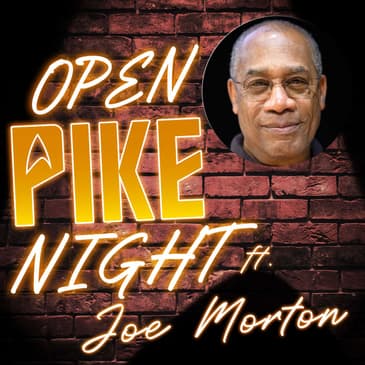



We give Joe Morton an Admiral's welcome as he stops by to discuss playing the iconic Trek badmiral! He explains the five questions he asks about every character, his pet peeve on set, how he takes his coffee, and even indulges us in some Terminator 2 fanboying. Hit it!
- Send your voice hail to OPN
- Email your call to openpike@gmail.com
- Sign up for the OPN Newsletter
- Visit our website OpenPike.com
- Please Check out our Merch
- Support us on Patreon
- Follow @openpike on Twitter
- Follow @openpike.bsky.social on Blue Sky
- Follow OpenPike on Instagram
- Follow Openpike on Youtube
[00:00:00] Hi, this is Joe Morton and you're listening to Open Pike Night. And now before we begin, none of you are named Kirk, are you? Is this thing on? Hello? Hello?
[00:00:34] Welcome to Open Pike Night, the Strange New Worlds Podcast where your personal logs are indicating that you've won a great battle, but you're boss to call the glory once again. I'm your host, John T. Boulds, here to chat with the newest member of an elite club for Star Trek fans. Leaders who get a little overzealous in the line of duty, shall we say? Joining me, of course, as always is my co-host, the man who knows just how hard to punch to give some high quality plausible deniability, Cameron Harrison.
[00:01:02] Yeah, that's right. I like my punches like I like my coffee. Really weak and pumpkin spice flavored. And unfortunately, Jesse asked Cam for a lot of plausible deniability yesterday and now he's recovering in sickbay so he could not join us. But here with us today, if you've enjoyed films in the last 40 years, you know his face, you know his voice. A man of action, a man of science, a man of such deep talent that Arnold Schwarzenegger gave him a hand.
[00:01:28] He brought us Miles Dyson, he brought us Roan Prope, and of course he brought us a brother from another planet. Please welcome Joe Morton to the Open Pike Night stage. Thank you. Thank you. It's great to talk to you. It's great to have you here on our podcast, man. It's great to be here. Sure. And it was so fun to see you in some new worlds. We saw you pop up in the trailer and everyone was excited. You know, when I was in college, I just, I loved Star Trek. It was, you know, everybody did.
[00:01:55] So when the offer came in that they wanted me to come in and do Admiral Rieger, that meant I was going to be sitting in the big chair. And I absolutely didn't know what the script was, hadn't read it yet. And I said, yes. You just saw the character name. Well, just because I knew I was going to be sitting in the big chair. Yeah. Yeah, absolutely. So were you a, were you a fan back from the original series days? Like what would you say is your... Yeah, back in the original series days. Yeah. In the sixties. Do you have a favorite character?
[00:02:24] I don't, well, I mean, I think everybody liked Captain Kirk, obviously. And I think for some of us, the fact that Uhuru became part of the crew and her name meant freedom and it was the sixties. I think that had some importance as well. Yeah. Did you ever get to meet Nichelle during your career? I never did. No. Well, I was, no, when she was on and that was on, I was in college. So, and then afterwards never got a chance to meet her.
[00:02:51] Did you get a talk with Celia on this set? I know you don't have any scenes with her, but... No. I did recently though, meet her mother. We're going to be doing something together. Oh, good. Oh yeah. Yeah. That's very cool. Yeah. Well, speaking of the big chair, I guess I'd like to jump straight to that. Sure. You have a very distinctive posture in the chair, very different from, from Pike's. Is that something you kind of worked on? Like how is Admiral Rieger going to sit here? Or was that instinctive?
[00:03:16] Yeah. I think, I mean, the two things that I did before I went to do the show is I wanted to make sure I was really thin because of those uniforms. Hair? Hair? Hair? And then in terms of sitting in the chair, I think I just let it happen as opposed to, and I know everybody kind of, most of the guys sit with their legs, you know, wide and on like this. I, there was something because he's an older guy and because he's, um, has a certain reputation.
[00:03:44] I took a little more casual kind of thing to it, but at the same time holding his back straight and, and making sure that he was still in command. Yeah. Yeah. Mm-hmm . And, and with that, like how was the role presented to you beyond, beyond the page, beyond just the words on the script? Did you have any conversations about what they were looking for? Not really. The director and I talked, you know, once I showed up on set and we started to work, she was great. I loved her. She was fantastic. Yeah.
[00:04:12] But no, there was nothing. I mean, I think the thing about television scripts usually is they are almost foolproof. The story is in the, in the dialogue. Mm-hmm . And what, what happens I think is, um, if an actor brings something to it, then suddenly the, the story lifts, really lifts off the page. So that's really what we did is just, just found things to make Rieger, uh, who he was.
[00:04:36] Um, I mean, the idea of someone who would be living on someone else's victory, if you will, um, and take it as his own. And then having to, the interesting thing about Rieger was, yes, he, he, he was not the savior everybody thought he was, but as he's pursuing his enemy, he's really clever. I mean, he knows what to do. He knows how to follow them. He knows how to use the engines. He knows all kinds of things. So on some level, you know, you have to give him credit for who he is. And I try to put those two things together.
[00:05:05] Mm-hmm . Mm-hmm . I like that. Well, speaking of, of the director and the first day on the set, it sounds like from the writer and the director and even the actors themselves, they all kind of shared a story about how, when you came on that first day, even for the walkthrough rehearsal, you were dialed in, you were prepared, you were in character. Oh yeah. And all the other actors kind of sat forward and were like, oh, we're doing this. We're bringing our A game. Got it. Yes. Is that something you always do? Or was that like, I'm Admiral Rieger. I've got to make a presence. That's something I always do. Okay.
[00:05:34] Uh, I think there's only one way to approach a set or a stage and that is to walk on it prepared. Um, so, you know, I did a lot of homework, made a lot of notes. And the one thing I really don't like when I get on the set is when I see other actors and they still have the page in their hand. Mm-hmm . I keep thinking, well, that was last night's work. So now you're, you're making me deal with your last night's work today.
[00:05:58] So that's why I feel like if I'm prepared, then it kind of puts, uh, and I'm the guest quote unquote guest star. Then it kind of puts everybody. This is how we're going. We should be doing things. You know, you can do it however you want when I'm not here, but when I'm here kind of, this is how I like to do it. Lead by example. Yeah. Yeah. Yeah. And like, so you did, you stepped onto set, you stepped on the star Trek set. Yes.
[00:06:23] And I was nervous. I was, I mean, I always get nervous, but I was nervous because it meant so much to me. So I had to sort of, you know, quell that a little bit and just get back to work and not be, you know, it's kind of like, um, being a fan boy of the show and then realize, oh, wait, wait, you're doing so. So you have to calm down.
[00:06:38] Yeah. And, uh, with that, like a lot of actors talk about how once they are on set and this is our first time putting on the uniform suddenly makes things feel more real to them. Did you have a moment like that with your, with your fantastic Admiral uniform? Yeah. I mean, you know, they, they actually, they make it for you so that when you put it on, it's, it will only fit you. So there was that process. And then once the uniform was finished, uh, me, you know, I immediately had people take pictures and I said,
[00:07:08] send it to my kids and, you know, so yeah, I mean, it, it really does help once you put on that uniform. Um, it's like, it's like, I suppose it's like anything else. You know, if you're playing Marine and suddenly you put on that uniform, you have to sort of fulfill what that means. Sort of an outside in process.
[00:07:28] Yeah, I suppose. I mean, I think it's a little bit for me, it's a little bit of both. Um, when I was in college, we kind of studied, we did study some of Stanislavski, but we also studied other things. So for me, it's a combination of putting all that together. You know, um, sometimes it's inside out. Sometimes it's outside in. Makes sense. For this shoot, for this episode, like what was the biggest challenge you found once production had started? What, what, uh, what made you work the hardest?
[00:07:55] It took me a minute to figure out what she wanted with the coffee in the very beginning. Oh, Hmm. Cause I was making more of it than that. And she wanted something more reserved, something more like someone, um, who was a connoisseur of wine kind of thing. So I thought, Oh, well that's interesting. So we played with that.
[00:08:11] I don't think there was any kind of moment where I thought, Oh, this is the kind of the big challenge. The big moment, obviously in the pieces, the fight at the end. Um, so there was some, uh, preparation for that. Obviously the stunt quarters came in and we worked all that out and then pulling him across the set. Um, and then getting hit, uh, getting shot, I should say. So all of that, um, that was the big moment. So it wasn't so much a challenge as it's, it's, it's, it's, it's just fun. Well, two followups. One, how do you like your coffee?
[00:08:41] Oh, I drink strong coffee. Yeah. I like strong coffee. Yeah. Black. Um, no, uh, half and half and one teaspoon of sugar. Okay. Okay. And then, yeah, Sharon talked about one of the big challenges being just kind of like finding the balance of Rieger. Like how big do we go? How soon do we go that big? Was that a challenge for you? Or was that just every take different and you can find it in the chat?
[00:09:06] Well, I think I kept, I kept reading the script. So I knew where I was obviously. Um, so that we could build up to the moment, the big fight at the end and so forth. And then, you know, the thing about a character like this is you're always dealing with a certain kind of truth, which is his truth. Mm-hmm.
[00:09:23] And his truth is he was the victor in that battle years ago. Um, and that he had somehow earned all of his reputation. So, so that particular truth is something I had to hold on to inside of me until it's broken. Until finally, when Jim says at the end, you know, here's what really happened. And he has to face it. And, you know, you have your, um, medal, is it medal of honor? A moment, you know?
[00:09:49] Right. Quick note from the editor's room. I'm now realizing he meant a few good men. You can't handle the truth. So it was one of those moments. And I, and I was looking forward to it. I thought, oh, that's what this is. And let's, let's go for it. We're glad you did. Yes. Uh, what about the most fun? What was the most fun?
[00:10:09] Hmm. I think just the whole thing. I just, cause I kept calling back to my partner saying, it's just a lot of fun. I just really had a good time. I had a good time. The entire time I was there, the cast was wonderful. Uh, Sharon was fantastic. The crew was really, really good. So it just really was a lot of fun from, from beginning to end. I didn't feel like, you know, there are some shows where it's, it's just a lot of work, but it's enjoyable, but it's work. This just felt like a lot of fun. I just enjoyed it.
[00:10:38] So we talked to the writer, Alan, who a lot of his favorite lines were callbacks to TOS lines. Some of your lines are calling back to lines we'll hear later in, in the original series. Did he talk to you about those? And if so, did you go listen to them or did you purposely avoid that? Yeah. He asked me if I'd, if I'd gone back to take a look at the original series, I said, I tried, I couldn't watch it. I couldn't do it. I'm not in college anymore, Alan.
[00:11:05] Yeah. And so he didn't specifically say, no, this is a flashback from the original series. Now that you've said that, I don't know that I even recognized that there were lines that were from the original series. It's your line about when you, you put in order 24, I guess when you say like in however many hours it will be destroyed and nothing laughter, I'm, I'm forgetting the line. I apologize. Right, right. But apparently Scotty says that in an episode of TOS where they do order 24. Oh, I see. Gotcha. Neither of us are the biggest TOS.
[00:11:36] But Alan is, and he was giddy hearing you perform that line. Oh man. You know, it's interesting. I mean, cause like I say, back in the day, I loved the series. You go back and try and watch it now. It's kind of like, ew. There's a lot of filler shots in those episodes. Yes, they really are. Yeah. Yeah, they really are. I mean, 60 years, 60 years. Yeah. Yeah. And how many, how many iterations of Star Trek? Oh. And I'm not talking about the films, just on TV. Oh, almost a thousand episodes. Yeah. And I think. Really?
[00:12:05] I think 11 series now. I can't remember how many series, but yeah, we're, we're close to it. There are 11 different series. Yeah. Either nine or 11. I'm blank on it real quick. This is math no man should do. For 10. Well, then 11, cause the animated series. Yeah. Ah, okay. Yeah. A lot of series, a ton of episodes. Have you, in your life since you've done this, have like Trekkies come out of the woodwork hearing that you were on this and making themselves known to you?
[00:12:33] Um, yes. Uh, I have a good friend who is a, she writes novels for teenagers. So she's, I'd forgotten she was a big, she's a big Star Trek fan. So of course the day after the episode, I get a big email from her. My partner's uncle is a priest or was a priest. He's a big Trek fan. So he sent her any big email. And then he said some leader of the diocese in Brooklyn is also a big fan and he loved it too.
[00:13:02] So it's amazing. Now you mentioned, as you were watching growing up, uh, aside from your story in this, uh, has got a pretty amazing, uh, action sequence and story herself. Like how did it feel seeing, seeing that after 60 years? Well, it was interesting. Cause now that I, I, I'd met her mother before I saw the episode.
[00:13:22] No. So I felt a little, I felt even closer to her in that regard. Yeah. It was great to see. And I knew a little bit about how she got into acting because her mom told me and it just, it, it was lovely to see her that, to see Uhuru that young, to see her. Um, and, and that occupied, not just sitting behind that desk, actually down on the ground as a soldier. So that was wonderful to see. Yes.
[00:13:46] Yeah. I agree. Yeah. What did you imagine Rieger was thinking when he realized that Kirk was going to be his second in command? Once again, was he, did he have any excitement about the do over potentially or apprehensive or how did you approach that?
[00:14:02] Well, what I did was I said, look, um, you, you can't, you've already said you want him to be your first officer. So you can't recant on that. I don't know how much he knows about the constitution and that, and that battle and, and the relationship between his father and I, and the way the dialogue was written is, you know, your father and I shared lots of cups of coffee and blah, blah, blah, blah. He was considered a friend.
[00:14:28] And things that I think Jim seemed not to know. Um, and I think the best way to tell a lie is to tell what sounds like the truth. Say, Oh yes, he was this. He was that. We were had cups of coffee. He wasn't necessarily the best man for combat. And then see how that plays. Um, just let it, just let it play. I know what I was there to do. And I know what happened. And I know, uh, I know enough that I don't know that the sons even doubt what their father was.
[00:14:58] I don't know that. So from what I do know, I was obviously incapacitated. He took over the ship. Um, somehow I came back in time, um, and changed the story and the story is mine. And I feel like, you know, I deserve it. So, so you, you, you, you know, what do you, you keep your friends closer, keep your enemies closer. That was sort of the idea.
[00:15:19] Hmm. Okay. No, yeah. Good approach. Yeah. So, I mean, I, I loved every facet of your performance from the, the charming Admiral that walks on and tries to schmooze everyone to that great scene with Kirk and the coffee to, you know, everything that happens at the end of this episode. Right. And I mean, it is a journey, so you're inhabiting this character and you're living the character's truth, but also are you thinking like, I need to be charming these early scenes to get the audience on my side? Like how much are you kind of thinking of a meta nature in that way?
[00:15:49] Never think that way. I think that's, I think that's how actors get in trouble. I want the audience to like me. Who cares? What you want is you want to fulfill the character. Who is this person? There are five questions I ask myself for every character I play. Who am I? Where am I going? Who do I expect to meet? And the last two of the most important, which is what do I want? And to what extent am I willing to go to get what I want?
[00:16:12] And, and for almost every line that I have in any script, I will apply those questions over and over and over and over again, looking for as much truth as I think I can put together. That makes sense for the character. That's great. That would be applied to this character specifically. Yeah, absolutely.
[00:16:28] Yeah. Well, there's another great moment I love where as Rieger is talking, you can kind of see him realize mid sentence that he's about order to the destruction of this planet. He, he stops and kind of see that light bulb. And then he continues. And again, Alan told us this was not scripted. This was something you brought to it. Was that something you had kind of pre-planned and thought about? Or did that happen in the moment?
[00:16:51] Well, I thought it's a huge decision to make to, to destroy an entire culture, an entire planet. I mean, that's really playing God. So I think realistically in that moment, I know I was thinking, so do I want to do this or not? That, what do you want? I want to destroy that ship. It killed my family. And to what extent am I willing to go to get it? Kill everybody. You know, just destroy the entire planet.
[00:17:20] So that's going through my head before he says, there's only one thing we can do is making the decision that it's necessary to go that far. So do you remember if you kind of made the decision to play it that way before the scene or? Oh yeah, absolutely. I take notes, as my partner will tell you, I take notes for everything so that I can walk in. And the reason I do that is I might take notes and make a decision about what I want to do.
[00:17:46] I want to do something. The director might come in and have a better idea. At least I have a blueprint. I know where I'm going and how I'm going to get there. And so that's, again, being prepared. Yeah, that's fantastic. And with that preparation, was there any backstory work you did for Rieger or anything that didn't really make it to the screen that you'd get to share?
[00:18:10] Not really. No. See, this is the problem of doing something a year ago. We definitely understand that. We've talked to writers three years after they've written something and feel bad every question we ask. So what was I thinking? I don't know. I mean, I know that I make decisions about what it is I'm going to attempt to do before I get to the set.
[00:18:33] So that's clear. Yeah, I don't. I even now have forgotten the question. What was the question? Did you like, were there any backstory developments or character development you worked on that weren't really, you weren't able to bring to the screen? Yeah, the only thing, yeah, like that my dad was in the army. Okay.
[00:18:53] He was a captain and he had a lot of responsibilities. So I brought a little of him to the character, what it means for a black man to become an officer with that kind of rank. And how quickly does that happen? Colin Powell was fast tracked as well. So I was looking and I played Colin Powell. So I was thinking of those kinds of things. Okay. Okay. That's very cool.
[00:19:18] So having grown up on TOS, were there, did you ever have any moments playing scenes with Kirk, with Spock where they kind of hit you? Hit me how? Just that you're like, you're in a scene with these iconic characters or, or did that kind of just wash over you when you first stepped on and after that it was business? Oh, I think the thing that impressed me about doing the series is the set. The set is just incredible. Yeah.
[00:19:47] That's, every time I got on the set, I was like, wow, it's just gorgeous. And it's huge. It's, I mean, as one might expect, but it is huge. So to sit in the big chair in front of that enormous screen or psych rather in front of you is just, that's kind of breathtaking.
[00:20:31] Mm-hmm. Yeah. You know, I took the fall every single time. Even though I said, well, you don't have to. I just thought, yeah, but she needs something to respond to, you know, so. Nice. Well, you get to see it in the white shop because of that. So. Yeah. Yeah. Again, thank you. Yeah, absolutely. Well, yeah, let's talk about that final scene where, and I want to ask, because a lot of people, there's a lot of discussion now about this episode of, like, should he have been drugged?
[00:20:58] Like, and I think that's one of the questions we're supposed to ask. Like, Kirk kind of did a bad thing, but for good reasons. Do you think Rieger could have been pushed to that edge without the cortisone? See, that's the thing. Probably not. He probably would have held it all together. He would have never would have struck another officer for sure. Because that just puts him over the edge. Once you've done that, then you've broken all the rules and nobody's going to listen to you at all after that. Mm-hmm.
[00:21:26] So, yeah, it would be interesting to, I didn't think much about it, but it would be interesting to think about what might have happened had he not been drugged. Because that one shot and we're all sitting around the coffee, and then I say came away, I wanted to see how this should be done, and the camera sort of slides in on the coffee. That's the only time even the audience is aware something is up. Yeah. That's a fun moment, because when you go back and watch it, you're like, oh, there's where Jim touches the mug. There's where he drinks. But, yeah, you don't know if it's the first time.
[00:21:53] And I didn't even notice Joseph looking at me when I drank that coffee, because he kind of does a side glance. And I thought, when I saw it again, I thought, oh, good. So, but in that scene, you know, I noticed Grieger is sweating profusely. I presume makeup or something you're using. That's another one of those moments where I'm like, it's not just character. You have to perform the sweat. You're conveying plotty information to the audience.
[00:22:21] But I was really taking, I felt like you had really kind of internalized and were using it to build the character. So maybe you kind of talked about this with the, you know, you don't think about the audience. But when you're kind of having to do things like, I have to convey this for plot. How do you kind of find ways to internalize that into the character? Yeah, we talked about it for a little while, because they didn't even want me to do what I did.
[00:23:11] Oh, yeah. Yeah. Yeah. Yeah. It definitely comes across as like, huh, that's weird that I'm sweating. I'd be like, I've been doing this Admiral thing for a while now. Right. I'm used to this kind of tension. So why am I sweating? Yeah. Yeah. Yeah. Very well done. Well, as we kind of lead into wrapping up, is there anything about the experience we haven't really asked that you'd like to share? The only other thing that the caps that they have, the baseball caps that they have, were gorgeous. I love them.
[00:23:41] So that's the only thing I kept nudging the producers saying, gee, I'd love to get one of those caps. Love to get one of those caps. Did it pay off? Did the nudging work? Yes, I did. Nice. Good. Oh, and that's so you asked about Trekkies. So when I finished, because, you know, they shoot in Toronto. So when I was getting on the airplane coming home, I had on the cap. Yeah. And one of the, I think it's one of the TSA guys kind of recognized the Delta. And he said, oh, I'm a Delta fan. I said, that's cool.
[00:24:12] That's awesome. So, and you were working with, sorry for the pun. You were working with the next generation of actors and of Star Trek actors. But what was it like working with them? How many fans did you have on that set? Well, I mean, I don't know. You know, what's interesting is these days when a cast goes backstage and they're waiting to, you know, while they're lighting and do whatever they're doing.
[00:24:41] It used to be where there was a lot of conversation. Now, everybody's on their phone. You're sitting in a room and everybody's doing this. So I'm like, oh, okay. So I bring a book. They were lovely. We actually went out to dinner one evening with Sharon. And all of us went out to dinner together. And they were really lovely. They were fantastic.
[00:25:05] And yes, it is the new generation pretty much wherever I go. These days, it's like, you know, I'm not surprised that I am the oldest person sitting in the room. Well, speaking of that history, John and I are film geeks of a certain age. So would you indulge us a Terminator 2 question or two? Sure. And we'll try to make it Star Trek related.
[00:25:34] And I think there are a lot of themes between that movie and this episode specifically about, like, what would you sacrifice to stop, you know, a bigger genocide? And it's, you know, Miles Dyson is kind of the planet, right? Like Sarah Connor comes and she's willing to sacrifice him to stop Judgment Day. But she stops because she sees a son.
[00:25:55] Going back to those five questions you asked yourself about Rieger, do you think there's anything Rieger could have seen or learned that would have made him stop his campaign? I mean, in a perfect world, had he been able to follow the ship perfectly and just do away with the ship, that would have been fine. Right. Because that was his objective, right?
[00:26:17] So once that ship lands, there are all those questions about what that ship's relationship is to that planet and to the people who live on that planet. But he obviously makes a decision saying, I don't care. Yeah. And I think the difference between that and Dyson, Dyson actually makes the decision that he will do something to change it.
[00:26:41] He wants to go back and destroy all that he has explored and invented. And even at the very, very end, you know, when the cops all come and he says, I don't know how long I can hold this thing. Yes. He used to tell him, go, get out, you know, you're in danger. So Dyson was completely someone who wanted to do the best for the world, where Rieger is someone who's doing the best for himself. Mm-hmm. That's a great comparison.
[00:27:11] I mean, we're living in an age now of like Dyson-like tech scientists who maybe could use a paradigm shift in that way. The other day I heard, I guess, this guy from Anthropic, Anthropic rather. He said this whole thing about, you know, AI will destroy mankind, blah, blah, blah. And I said, well, you know, there was a movie about that. Meaning that James is kind of ahead of his time.
[00:27:37] And he actually did give me a lot of AI stuff to research before we did the film. But that film basically is saying if you don't control your technology, it will take over. It will take you over. And it wasn't the first film like that of its kind. There's been a bunch of films where the technology is the culprit because mankind has built something beyond our own, not only mental capacities, but our own moral capacities.
[00:28:06] You know, I kept thinking that on some level, Rieger, and I don't know what anybody's politics are here, but Rieger is kind of like Netanyahu. He just decides my enemy is there, so kill everything. Then I don't have to worry about it. Whereas I think Dyson clearly when presented with the problem makes the choice of, oh, no, no, we have to stop this. Yeah. Love that insight. Right. Yeah.
[00:28:32] I mean, just growing up, Miles Dyson was kind of always like the paradigm of like the honorable man, the man who sacrifices, the man who can take in information and learn. And I think, yeah, us at that age, like that was a big deal, I think. So thank you. I was completely surprised by everybody's response to that character. Really? Really? And to, well, there were three other characters that are a lot bigger than me in that movie.
[00:28:58] But it was, because I remember the movie opened, we were in California, some mall somewhere, and a bunch of kids, teenagers, or maybe they were older, come running out of a restaurant and like, oh, we just saw the movie, we thought you were great, love that death gene and blah, blah, blah. And I thought, wow, you know, we came back to Brooklyn and my kids up for a walk. And suddenly we were surrounded by teenagers who had seen the movie.
[00:29:25] The thing was he at the time, because he was very young, he had never seen the movie. He was less than 10 years old. And we walked into some shop that sells whatever gizmos the kids were into in those days. And I look around and every TV is on and I'm on every television and I'm about to die. Oh, no. Oh, no. So my wife at the time and I look at the person behind the desk and sign a signal like, we have to get this done quickly and get out of here.
[00:29:56] She doesn't quite figure out why, because obviously she hadn't seen the movie. She didn't know what we were referring to. She did get us out, however, before the cops come in and shoot me to blow up the building. That's funny. That's fantastic. Yeah. I mean, like, again, we were, I don't know, what, 12? Was that movie? Yeah. And it was the first movie I ever saw on DVD and like slow motion, like frame by frame, checking out the special effects and stuff.
[00:30:25] But it, you know, the way you perform that character, Miles Dyson is like so notable that when I watched executive decision later and you popped up on screen, like, sweet. I already like this movie even better. And it's like, oh, he's paralyzed. Like, nope, he's still doing great. He's carrying this movie. I love it. Executive decision. Now there's another one, right? So that movie happens before 9-11. And that's what that movie was about. It's kind of spooky that way. Yeah.
[00:30:55] A lot of pressure in films. Yeah. People watch Joe Morton movies and take heed. There are lots of them. Watch this. This is the future. Yeah. Well, yeah. I mean, we spent a lot of time trying to think of like a Terminator 2 question. He hasn't heard a lot. And so we're just going to fall back on one of our friends who was texting us while she was watching this episode and freaking out about seeing you. She's a big Linda Hamilton fan, a big Sarah Connor fan. And her question is, were her biceps as big in person as they are on screen?
[00:31:23] We were, I guess I guess we were in San Jose when we were getting ready to blow up the building. And I got on the elevator to go to breakfast or whatever. And Linda was coming back from her workout and I was embarrassed. She just was so pumped. She looked so gorgeous. I mean, she looked, she was fantastic. Yeah. No, she, she, she put on the muscle for sure. Yeah. So you didn't, you didn't call her though and be like, Hey, I need some workout tips. I've got to put on this Admiral uniform. No, no.
[00:31:53] We run into each other every once in a great while at, you know, conventions or whatever. But yeah, she was, she was fantastic in that movie. And, and I'm sure, you know, the idea of the, the authoritative characters being the Terminators was her idea. I, I don't know if I know that. All right. That was her idea. Interesting. Okay. Very cool. Well, Joe Morton. Yes. Open Pike night is an open mic night themed podcast.
[00:32:21] And so we do ask our guests to prepare a joke. Do you have a joke for us today? I do. So a man is sitting around in his house and there's a knock at the door. He opens the door. He doesn't see anyone. He looks down. There's a snail. Picks up the snail and chucks the snail out. Doesn't think anything about it. Closes the door and walks away. Six months later, there's a knock at the door. He opens the door. Nobody's there. He looks down. There's the snail. The snail says, what the fuck was that all about?
[00:32:53] Oh, it's fantastic. I've heard that joke before, but I don't think as good, as well delivered as Joe Morton just delivered it. That is my favorite joke. If somebody asked me what my favorite joke is, that's the one. Love it. Well, thank you again so much, Joe, for the book coming on and the amazing performance. Definitely an iconic Baton role from Star Trek. Thank you. Thank you.